Tuesday, January 11, 2022

Pritti is Watching From The Other Side of The Rainbow Bridge

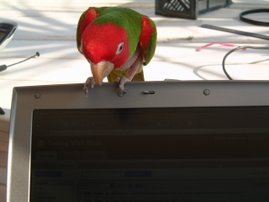
Quite a while has passed since the last update about Pritti, the beautiful, talented, brilliant Red-Masked Conure/Cherry-Headed Conure.

Pritti passed over the rainbow bridge at age 33.  That is considered a nice ripe old age for his species.    Pritti's talented avian vet in Deerfield Beach, Florida started giving us gentle warnings about Pritti's deteriorating health when Pritti was in his early 20's.  Despite those "conditions," our Pritti was not ready to leave us until he was 33 years old.  Some other things happened in our family at that time that caused one family member to say that Pritti left us so we could take care of a human family member that had life or death critical medical needs that required months of attention and support.  I don't know if that is true, but Pritti remained in our hearts and and minds and we will never ever ever EVER forget Pritti.  

Wednesday, June 15, 2011

Pigeons Are Not the Only Birds in Manhattan.


Migratory birds wintering in the south.

As a 30-year Manhattanite, I think of pigeons when I think of the island's birds.  Everywhere you go, there are pigeons, sometimes many many many pigeons.  There is a great scene in Home Alone 2:  Lost in New York, where the McCauly Caulkin character meets the Bird Lady in Manhattan, New York's Central Park.  It is night, and the Bird Lady is standing like a statue with pigeons all over her, coat covered in bird droppings.   She was their Home Base.  So those are the birds, from white through many shades of gray to a silvery black-blue, all are multicolored in some way.  They peck around at everything they can get their tiny, pointy beaks on.   

But the NYC pigeons are not alone.  In fact, Central Park, which is surrounded by buildings, is one of the Northeast's best spots for bird watching in spring and fall.  The vast city park with hills, lakes, trees and meadows is a welcome resting place for birds making their northern and southern migrations when the seasons change in spring and fall.  The migration starts as far as South America and as far north as Canada.  There are numerous other parks in Manhattan that also are visited by the migratory birds.   

Tuesday, May 10, 2011

Screaming, Screeching Bird Help - Part One

Our pretty cherry-head (red-masked) conure can scream with the best of them.  If you have every met one, you know what I mean.  In fact, the literature about this species always talks about how loud they are.  However, I have found that he is no different than any toddler that wants something but can't express her/himself in "human" language.  But, lucky for him, I can talk with birds.  And, so can you.

First you will take notice of the screaming details:  Where exactly is the bird when it occurs - and I do mean "exactly".  Is he in a specific spot on his perch, cage, etc.?  Where exactly is everyone and anyone else in the home?  What is going on in the home (music playing, TV on, kids around, someone talking on the phone, water running (where), food cooking (what kind), lighting, etc.  Seriously, if you want to figure this out and find a calm and quiet way to live in joyous harmony with your screamer, then start a journal.   Do this for a full week and include as much detail as you are willing to manage.  Include details about what physical activity for the bird preceded and followed the screaming episode.  Then come back to www.talkingwithbirds.blogspot.com to read "Screaming Bird Help - Part Two".  We will discuss the patterns that may be emerging from your screaming journal.

Our pretty little parrot has devised his own way to train and control us by the way he uses screaming, among several other activities.   Through my observations and conversations with him, I have been able to build some balance, peace, and fun in to our communal living situation (human-bird).

Our precious feathered friend has been with us for nearly 30 years.  So if you plan a long and happy relationship with a bird that screams a lot, this is a very worthwhile task to take on.

Saturday, May 7, 2011

H2O ~ WATER ~ AGUA

Your bird relies on you to provide all the resources he or she needs for life. Like humans and most other creatures, your bird needs fresh water. There are two schools of thought about water straight from the tap vs. using filtered or bottled water. If your water comes from a municipal water supplier, then you are probably aware that it will likely contain certain chemicals at or below levels set by the government for clean and safe water. One of those chemicals is often chlorine. Chlorine could be beneficial as a way to prevent bacteria from forming in your bird's mostly stagnant water dish. A bird's water can easily become tainted when he or she drops food or toys or poop in the dish. This is especially true if your bird uses this same water dish for bathing. That is why some veterinarians recommend using this processing, chlorinated water which keeps bacteria at bay longer than spring or filtered type of water. For those that have a strong preference to supply your bird with spring or filtered water, it is recommended that you change the water at least two times per day; more often if you see the water is soiled with debris of any sort, even a piece of fresh vegetable.

Water is your bird's lifeline. Keep it fresh and safe. Your bird will love you for it.

Sunday, June 22, 2008

What Spock Has Been Up To...


After a winter hibernation, Mr. Spock has chewed his way out of his cardboard hideaway.  He does such a thorough job and enjoys it so much that we are thinking of going in to the confetti manufacturing business.  Spock will be our main engineer.  

Saturday, December 15, 2007

Bird Words

A...B...C...
Bird words that are used to describe some humans and/or their traits:

Birdbrain
Chicken
Crowsfeet
Cuckoo Bird
Egghead
Featherbrain
Jailbird
Songbird
Snowbird

Hmmm. Some of these even describe birds. Can you think of any others. Post your reply by clicking on "comments" below.

Monday, October 22, 2007

FEATHERS ARE:

Feathers donated my Mr. Spock. These are his tail and wing
feathers shed during the molting process over many years.

Mr. Spock

If it has feathers...it is definitely a bird. That is to say, only birds have feathers. Furthermore, all birds have feathers...no feathers?...not a bird. While all feathers generally have the same basic elements, they can vary tremendously in appearance, shape and size. That is because different types of feathers have different functions. For example, the long and strong tail and wing feathers are primarily involved in flight. Various types of smaller and softer feathers provide insulation from water and cold.

According to wikipedia "Although feathers are light, a bird's plumage weighs two or three times more than its skeleton" http://en.wikipedia.org/wiki/Feather. That reminds me of the old riddle from when I was a kid: Which weighs more, a pound of rocks or a pound of feathers?

Sunday, October 14, 2007

Bird Toys


A pet bird, such as a parrot, should have a bunch of toys. It's a good idea to no let a pet bird have them all at the same time. Mr. Spock, our cherry-head conure, has lots of toys and interesting things in his cage and on his playpens. Sometimes a new toy will be there for weeks or even months before he tries them out. Then one may become his new favorite for a while. Six or eight toys would be a good start. Some of Spock's favorite toys are not even store bought. He LOVES the cardboard tubes from paper towels...he rolls them, flips them, flings them, etc. Sometimes I even hang them on a rope in different places for him to play with. It's a good idea to rotate toys every six months or so...move a couple out and a couple in.

Wednesday, September 12, 2007

A Birdseye Vision


Did you know:

Birds see in color. I've known that for a long time, because our choosy Cherry-head Conure, Mr. Spock, eats his food in color order. Yes, just like a human might choose to eat jelly beans or M&Ms (click here to read about it). In fact, birds can see colors better than humans. It has to do with lenses and cones (not ice cream cones, but the cones that make up the eye), which allow them to see a greater range of the ultraviolet wavelengths than humans. That may be another reason why our pretty parrot can be found entranced with his image in anything reflective. If there is a mirror or a metallic object near by (even a spoon), he can be found snuggled up to it staring at his bright red crown and gorgeous green body. Oooh La La !!

Saturday, August 25, 2007

Parrot POW - Post Traumatic Stress Syndrome

Mr. Spock, our cherry-head conure, just returned from a week-long stay at the bird hotel in South Florida while we were away. Even though he had his some of his favorite toys and snacks along with the company of lots of other beautiful and exotic birds, he still came home freaked out. This is unusual for our lively parrot; usually he is friendly and grateful for being liberated. Sometimes he would pretend to be mad for a few minutes, but would get over that quickly and return to his normal bird behavior.

This time though, for two full days, he was like a cat on the attack, or a like a cornered snake. As soon as I would get near him...his eyes would bug out, he'd back up, get a good footing, and lunge at me with the big beak snapping. Yikes! There were several near hits, and a few direct strikes on my finger. There he was...biting the hand that feeds him. By the third day (yesterday), he was as cute and cuddly as ever...snuggling up to the hand that feeds him. Welcome Back Mr. Spock!

Sunday, August 19, 2007

Sanderling: A Very Cute Seashore Bird


The Sanderling could possibly one of the cutest birds ever. This is the small bird that you can see on a beach at the shorline. It might be mistaken as a baby seagull or some other young bird. However, it is most likely a Sanderling. South Florida beaches are abundant with Sanderlings who seem to love chasing waves.


The Sanderling is a common shorebird that turns up on almost every beach in the world. They are the cute little birdies that run up on the beach when a wave rolls in, staying just ahead of the breaker. Then, as the wavwe recedes, the Sanderlings sprint after the retreating water. They look like they are playing a game of trying to get as close to the water as possible without letting it touch them. They are actually waiting for tiny bits of food to be deposited from the ocean on to the sand for them to eat.

Friday, August 3, 2007

Why Do Birds Fly in "V" Formation?


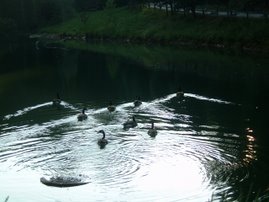
When late Fall rolls around, we will begin to see the migration of geese from northern areas,of the United States and Canada to the warmth of Florida and other southern states. You will recognize them as geese by their V Formation, flying long distances high in the sky.

According to the Library of Congress Research Center's website, and a multitude of other sources, there are two reasons the geese fly in V Formation.

1. Energy Conservation:
The V Formation shape actually reduces the drag force a bird experiences when flying alone. Since each bird flies slightly above the bird in front of him, there is a reduction of wind resistance. The front bird in the lead position works the hardest. So the birds take turns being in the front, falling back when they get tired. In this way, the geese can fly for a long time before they must stop for rest. If you are interested in the physical science of this phenomenon, check out aerospaceweb.org.

2. Communication:
The second benefit to the V Formation is that it provides the birds with good visual contact of each other. They can do a better job of making sure the flock stays together.

Thursday, August 2, 2007

Acupuncture...It's For the Birds !

These days it seems many people know something about Acupuncture. Perhaps you have received the treatment, know someone who has, or have read an article about this Traditional Chinese Medicine (TCM) modality. But have you heard of veterinary acupuncture?
To keep this article short and sweet, I have included many clickable links if you are interested in more information.

Acupuncture has been practiced on humans in China for almost 5,000 years. Fast Forward to modern day: According to a National Geographic article, U.S. veterinarians have practiced Acupuncture on animals since the 1970s. The desire for complementary medicine treatments for our pets has been on the rise. Most often Acupuncture is provided to dogs, cats, and horses. However, more and more birds are being treated with this ancient healing modality with incredible success. The American Veterinary Medical Association issued a interesting press release, July 14, 2007 entitled "Complimentary and Alternative Veterinary Medicine - Such as Acupuncture, Herbs and Chiropractic - Becoming More Mainstream" (the title explains it all).
Do you know a non-human who has received acupuncture. Post your story by clicking "comments" below.


Wednesday, August 1, 2007

Bird is Back

"What kind of crazy grass is this under my feet?"

A Big Hello and a Loud Squawk Squawk Screech Screech from me and Mr. Spock, the Royal Cherry-Head Conure of Palm Beach County. We have been conspicuously absent during the past few weeks taking care of a bunch of things here at the nest. Thanks for all your emails to check on our pretty parrot during our absence.

South Florida is very hot and seriously steamy. But Mrs. Spock is happy at home in his comfort controlled environment. He is behaving and having a great time in his new habitat. He's still finding new niches to investigate, interesting ways to play with his myriad of colorful toys and mirrors, and taking cat naps next to his fuzzy purple sleep buddy. Even though the door is open most of the time, we find him going in and out of the cage all the time...enjoying the luxurious space.

So check back daily for the scoop. We have lots of good stuff to post. And...don't forget, Mr. Spock would love for you to make this your favorite page for doing all your Google and Amazon searches, and all kinds of shopping too. Have a Great Day!!

Tuesday, July 10, 2007

Birds of a Feather Swim Together


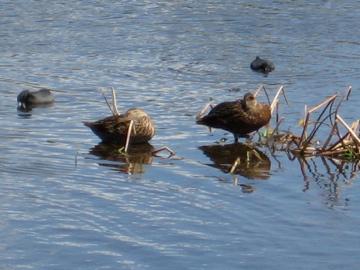
On a warm summer day in South Florida, everyone wants to be in the water., especially the birds. Ever notice that birds don't like to swim with humans? They swim with fish, snakes, frogs, mosquitoes, various reptiles, etc., but not humans. Hmmmm. What makes them better to swim with than humans? At the Wakodahatchee Wetlands in Delray Beach, Florida, you can find up to 140 species of birds lounging in and about the water, like this sleek loner. I'm not sure what type of wild bird this one is. Do you know? Test your bird knowledge and click here to visit the Wakodahatchee Wetlands website and see if you can figure out which bird this is. When you do, let us know. Just click "comments" below and post your message (you don't even have to register). I asked Mrs. Spock, our Sr. Consultant, cherry-head conure, to help identify this bird, but since he doesn't get out much, he couldn't say for sure.

Wednesday, July 4, 2007

Flew in For Independence Day


Look who I found out in my South Florida backyard today. Mama Duck was resting with the chicks in the shade under an ixora bush along side the patio. Mama Duck got a little nervous when I showed up and made a mad dash with the little ones in to the lake and swam away. I'll find them again tomorrow.

Aren't they the cutest !

Monday, June 18, 2007

The Birds of Smallwood & Sullivan County, New York

Cedar Waxwing

Summer in Sullivan County is abundant with the beauty of wildflower meadows, lush green rolling hills, farmlands, forests, and of course, many beautiful birds. In fact, the Sullivan County Audubon Society says "Sullivan County is one of New York State's birdiest counties." The Audubon Society reports that in one year there were 129 species of birds sighted just in the Township of Bethel, home to the lovely community of Smallwood. Other Towns in Sullivan County report impressive bird sightings as well. You can view details and photos at http://www.sullivanaudubon.org/. So how about spending and hour or a day talking a nature walk, or sitting quietly by a lake or under a tree and keeping an eye out for the birds. How do you keep them around. Do what we do. Talk with the birds. Try quiet clicking sounds with your tongue against your palette, or whistles, or maybe even a squawk.


The Sullivan County Bald Eagle population in the mid-1970's was estimated to be "two." That's right "2." However, in 1990 New York State purchased 12,000 acres in Sullivan County and created one of the largest bald eagle preserves in the country. The word about the preserve is out because the winter bald eagle population of Sullivan County swells to about 100. Most of these eagles are 'snowbirds' and return to their homes in February and March. But there are still bald eagle watching opportunities throughout the year in Sullivan County and nearby. For more information, you can visit www.catskillhikes.com/eagles.html.

Visit us again for more travel and tourism and talking with birds. If you have a bird photo you would like us to post at http://www.talkingwithbirds.blogspot.com/, send an email to talkingwithbirds@yahoo.com.

Don't forget to click on the "comments" link below this article to share your thoughts with us and our readers. See ya soon!

Wednesday, June 13, 2007

Unspoiling our Bird - Part Two - Going Mobile

In Part 1 of this series, we described the large and luxurious new home base cage we set up for Mr. Spock to begin the unspoiling process.

The next step toward unspoiling Mr. Spock, our 25 year-old controlling cherry-head conure, was to purchase a new "playpen" for him so that he can have familiar comfortable surroundings wherever he goes in our home. He already has a "play area" in our office, but the new "mobile" addition gives him more options. It has a ladder, swinging toys, a high perch, low perch, food and water dishes, etc.

So, right about now you may be asking "exactly how is this unspoiling our precious parrot." I'm kind of questioning it myself. (Just kidding.) Actually, it's working. This is all part of our master plan to be able to have Spock close by whenever he starts feeling restless. Even though his cage is wide open when we are home, he does get restless from time to time. That's when the spoiled brat-bird in him starts to rear it's un-pretty head. The screeching begins. Sometimes he is letting us know he doesn't want to be alone while we are in another room. Other times, he may want some of what we are cooking or eating, or might want a light out or a light on, etc.

So, now that we have a mobile playpen for him. This has served to quiet the pesky parrot every time. It has cut out on a lot of screaming matches between us and him. And...since screaming is our bird's specialty, he is usually the winner of any Call of the Wild match. So now our little talks with Mr. Spock are more conducive to harmony in our home.

So, we highly recommend mobile playpens.

Thursday, June 7, 2007

Unspoiling Our Bird - Part One - The first day home


Hello All,
It's been about a week since the last post because our extra focus and efforts have been on the "unspoiling of Mr. Spock." It began when our 25 year-old, cherry-head conure returned home from the hospital last week after a 14 day stay. The first phase of his hospital stay was for acute care, then it was more like in-patient rehab for the rest of our pretty little parrot's stay.

Over time, we have come to realize that Spock has been running our household, setting his rules, creating the schedules, telling us what to do, and so on. So we thought his homecoming would be a good starting point for us to begin on an even footing with him. Thus the beginning of "Unspoiling Our Bird." We had a plan would talk it over with Spock.

He arrived home to find a very large new cage, as opposed to the large previous cage. Bunches of new and interesting toys. A few of his new toys were just fresh new replacements of the identical toy that he had been playing with and demolishing for a long time. He adapted to the new cage and it's new location very quickly. We thought that it would be an easier adjustment for him to come home to everything new after the two weeks in the incubator at Backos Bird Clinic in Deerfield Beach, rather then just making the switch while he still called the old cage "home." Now, mind you, Mr. Spock is not confined to his cage too often. In fact, he has significantly more "open door" time than he does "locked door" time. It's his choice to be inside or out.

So, a recap so far of how we are unspoiling our cheery cherry-head conure: Big New Cage ! Lots of New and Fun Toys! Moving furniture around to create the perfect aviary space for him. Access in and out whenever he wants. Hmmmm....maybe we need to take a better look at this plan. But seriously, there is a plan. Tune in again to http://www.talkingwithbirds.blogspot.com/ for Part Two in the series "Unspoiling Our Bird."

Tuesday, May 29, 2007

Welcome Home Pretty Parrot !

Yay! Mr. Spock is back home. Our 25 year-old cherry-head conure returned home from a two week hospital stay at Backos Bird Clinic in Deerfield Beach, FL, where they took excellent care of him. He is happy and perky and show no signs of the nasty infection that was affecting his breathing.

Our healthy bird arrived home to his brand new supersized cage, with all new toys, perches and playthings. He hasn't even seen his playpen in the other room.