Showing posts with label birds. Show all posts

Wednesday, June 15, 2011

Pigeons Are Not the Only Birds in Manhattan.


Migratory birds wintering in the south.

As a 30-year Manhattanite, I think of pigeons when I think of the island's birds.  Everywhere you go, there are pigeons, sometimes many many many pigeons.  There is a great scene in Home Alone 2:  Lost in New York, where the McCauly Caulkin character meets the Bird Lady in Manhattan, New York's Central Park.  It is night, and the Bird Lady is standing like a statue with pigeons all over her, coat covered in bird droppings.   She was their Home Base.  So those are the birds, from white through many shades of gray to a silvery black-blue, all are multicolored in some way.  They peck around at everything they can get their tiny, pointy beaks on.   

But the NYC pigeons are not alone.  In fact, Central Park, which is surrounded by buildings, is one of the Northeast's best spots for bird watching in spring and fall.  The vast city park with hills, lakes, trees and meadows is a welcome resting place for birds making their northern and southern migrations when the seasons change in spring and fall.  The migration starts as far as South America and as far north as Canada.  There are numerous other parks in Manhattan that also are visited by the migratory birds.   

Friday, August 3, 2007

Why Do Birds Fly in "V" Formation?


When late Fall rolls around, we will begin to see the migration of geese from northern areas,of the United States and Canada to the warmth of Florida and other southern states. You will recognize them as geese by their V Formation, flying long distances high in the sky.

According to the Library of Congress Research Center's website, and a multitude of other sources, there are two reasons the geese fly in V Formation.

1. Energy Conservation:
The V Formation shape actually reduces the drag force a bird experiences when flying alone. Since each bird flies slightly above the bird in front of him, there is a reduction of wind resistance. The front bird in the lead position works the hardest. So the birds take turns being in the front, falling back when they get tired. In this way, the geese can fly for a long time before they must stop for rest. If you are interested in the physical science of this phenomenon, check out aerospaceweb.org.

2. Communication:
The second benefit to the V Formation is that it provides the birds with good visual contact of each other. They can do a better job of making sure the flock stays together.

Thursday, August 2, 2007

Acupuncture...It's For the Birds !

These days it seems many people know something about Acupuncture. Perhaps you have received the treatment, know someone who has, or have read an article about this Traditional Chinese Medicine (TCM) modality. But have you heard of veterinary acupuncture?
To keep this article short and sweet, I have included many clickable links if you are interested in more information.

Acupuncture has been practiced on humans in China for almost 5,000 years. Fast Forward to modern day: According to a National Geographic article, U.S. veterinarians have practiced Acupuncture on animals since the 1970s. The desire for complementary medicine treatments for our pets has been on the rise. Most often Acupuncture is provided to dogs, cats, and horses. However, more and more birds are being treated with this ancient healing modality with incredible success. The American Veterinary Medical Association issued a interesting press release, July 14, 2007 entitled "Complimentary and Alternative Veterinary Medicine - Such as Acupuncture, Herbs and Chiropractic - Becoming More Mainstream" (the title explains it all).
Do you know a non-human who has received acupuncture. Post your story by clicking "comments" below.


Tuesday, July 10, 2007

Birds of a Feather Swim Together


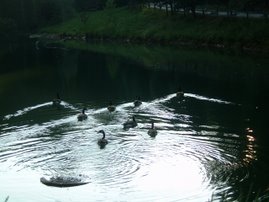
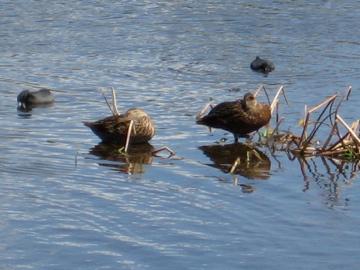
On a warm summer day in South Florida, everyone wants to be in the water., especially the birds. Ever notice that birds don't like to swim with humans? They swim with fish, snakes, frogs, mosquitoes, various reptiles, etc., but not humans. Hmmmm. What makes them better to swim with than humans? At the Wakodahatchee Wetlands in Delray Beach, Florida, you can find up to 140 species of birds lounging in and about the water, like this sleek loner. I'm not sure what type of wild bird this one is. Do you know? Test your bird knowledge and click here to visit the Wakodahatchee Wetlands website and see if you can figure out which bird this is. When you do, let us know. Just click "comments" below and post your message (you don't even have to register). I asked Mrs. Spock, our Sr. Consultant, cherry-head conure, to help identify this bird, but since he doesn't get out much, he couldn't say for sure.

Monday, June 18, 2007

The Birds of Smallwood & Sullivan County, New York

Cedar Waxwing

Summer in Sullivan County is abundant with the beauty of wildflower meadows, lush green rolling hills, farmlands, forests, and of course, many beautiful birds. In fact, the Sullivan County Audubon Society says "Sullivan County is one of New York State's birdiest counties." The Audubon Society reports that in one year there were 129 species of birds sighted just in the Township of Bethel, home to the lovely community of Smallwood. Other Towns in Sullivan County report impressive bird sightings as well. You can view details and photos at http://www.sullivanaudubon.org/. So how about spending and hour or a day talking a nature walk, or sitting quietly by a lake or under a tree and keeping an eye out for the birds. How do you keep them around. Do what we do. Talk with the birds. Try quiet clicking sounds with your tongue against your palette, or whistles, or maybe even a squawk.


The Sullivan County Bald Eagle population in the mid-1970's was estimated to be "two." That's right "2." However, in 1990 New York State purchased 12,000 acres in Sullivan County and created one of the largest bald eagle preserves in the country. The word about the preserve is out because the winter bald eagle population of Sullivan County swells to about 100. Most of these eagles are 'snowbirds' and return to their homes in February and March. But there are still bald eagle watching opportunities throughout the year in Sullivan County and nearby. For more information, you can visit www.catskillhikes.com/eagles.html.

Visit us again for more travel and tourism and talking with birds. If you have a bird photo you would like us to post at http://www.talkingwithbirds.blogspot.com/, send an email to talkingwithbirds@yahoo.com.

Don't forget to click on the "comments" link below this article to share your thoughts with us and our readers. See ya soon!
Friday, April 27, 2007

A Nice Place For Birds in South Florida

Wakodahatchee Wetlands, Delray Beach, FL

Here's a photo of typical Florida wetlands. South Florida is in the midst of a serious drought. The special wetlands that are operated by the local water departments are so very important to our birds at a time like this. These wetlands are safe havens for the birds to live, breed, raise their young, play, eat, and just have fun. The "natural" wetlands in the undeveloped areas of South Florida are having very serious drying out right now. In a short time, the rainy season for our subtropical oasis will begin, then we will be watching our lakes and canals wondering if they will overflow in to our living rooms. But for now, I am happy to say that the birds who find these beautiful wetlands managed by our water departments, are happy and healthy.

Tuesday, April 17, 2007

Global Warming...Global Confusion? Which Way is Up for Migrating Birds?

This has been a strange winter, which apparently is still not over. There was just a major snowfall in the Northeast this past weekend. I recall hearing news of recent winter temps in March 2007 as high as 80 degrees in New York, while South Florida was experiencing 50 degree temps at the same time. If we humans are having trouble deciding what kind of jacket to wear, imagine how the birds must feel! After all, birds don't migrate by a pocket planner calendar. If the weather is saying summer, but it is really winter, how do the birds know if they are supposed to be coming or going? I don't want to make this point with lots of dry statistics. We all have common sense and can use logic, or even our imaginations to see what a problem this already must be for migrating birds. Sometimes we forget that people aren't the only Snowbirds who travel from north to south to escape the frigid temps and spend a wonderful winter nesting (or vacationing) in South Florida.

Monday, April 16, 2007

CONGRATULATIONS MITCH & KAREN!

"It Must Be Love"


I would like to say Happy 15th Anniversary to Mitch and Karen. These two humans are like more like Love Birds! We speak the same language. They celebrated with the annual renewal of their wedding vows. Send them your good wishes by posting a comment here. Just click comments below.


With Great Affection,

Mr. Spock
Senior Consultant http://www.talkingwithbirds.blogspot.com/

Tuesday, April 3, 2007

Migration...Birds of a Different Type

The annual Springtime Snowbird migration is officially underway. April is the time of year when these unique birds begin to tidy up their winter nests and embark on their journey north. As things "heat up" in subtropical Florida, the Snowbirds take to the road, rails and the air to make their way to more temperate areas of the US and Canada. The signs of it are everywhere in South Florida...it begins with the sudden appearance of car carrier trucks stopped at shopping plazas adjacent to the "55 and over" communities, loading up with Toyota Camrys and Lincoln Grand Marquis. The mass pre-closing of hurricane shutters across condo high rises along the ocean is another telltale sign of migration. Other hints of the northern migration include the shorter wait times at banks and restaurants, and talk among the birds about flying dates. The Snowbirds will be back in the Fall when places like New York, New Jersey, Massachusetts, Ohio, and Montreal show the first signs of dipping temps. After all, these birds don't have feathers to keep them warm.

What have we learned: Not all birds have feathers...and...some birds prefer to take the train rather than fly.

Monday, March 26, 2007

Air & Sea: Birds and Dolphins in Harmony


What a surprise to find these pretty birds at the Miami Seaquarium in Florida (also called home of Flipper the TV dolphin). When I entered the gates, who was I greeted by but a pair of Macaws. The human representative with them assisted as a translator in talking with the birds .... introductions, sharing kisses, and photo ops, etc. On the other side of the park, tucked away in a little corner are these regal, friendly, and well behaved tropoical birds. Only a bird lover would go to a seaquarium to swim with the dolphins, and come home with more photos and memories of the birds than of the dolphins. (The dolphins are were great too. So smart and playful. Smooth silky skin.)

But back to the birds now. Having a home for the birds in the park offers a great contrast of living creatures to see and think about. There were the wonderful water creatures, many of which were large to gigantic in size (dolphins, manatees, orca whales), and of dark or muted colors, with smooth or shiny skin, and oh-so-quiet. In contrast, there were the light, feathery, air creatures in all the glory of their intense colors...our bird friends...and oh-so-noisy they can be. Visitors were delighted to stroll through the bird habitat and absorb the fun and sensational colors, listen to the raucous sounds, and watch them cooing over each other. The birds were not in cages, and were free to move about. However, most of them were content to just sit on a high perch with his or her partner and show off.

The Miami Seaquarium was a nice way to spend an afternoon. Don't miss the Topdeck Dolphin show. The swim with the dolphin experience wasn't too shabby either.

Bring a camera.

What have we learned? Surprises are everywhere...keep looking for them.